
Health Tests for Newborns and Babies in Bengaluru
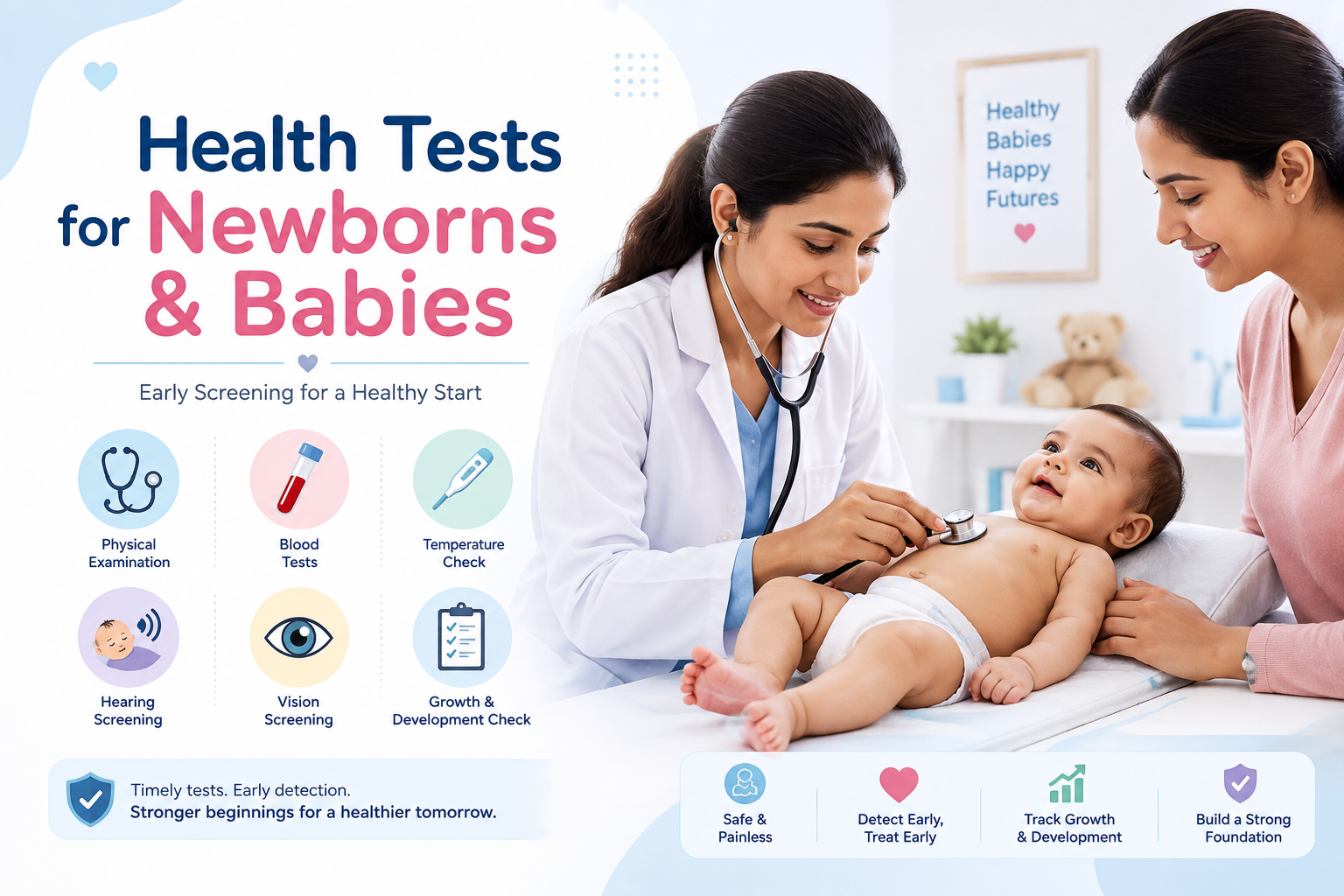
If you are a new parent searching for health tests for newborns and babies in Bengaluru, it is completely natural to have questions about which tests are actually necessary, when they should be performed, and whether your baby needs blood collection.
In particular, Bengaluru new parents and first-time mothers often receive several recommendations during the first few days or weeks after delivery. However, not every baby needs the same set of tests. Instead, screening depends on the baby's age, birth history, symptoms, family history, feeding, physical examination, and the pediatrician's recommendations.
Moreover, some newborn screening tests are performed soon after birth, while others are ordered only when a particular risk or symptom is present.
This Blog Includes:
 Essential screening tests for newborns and babies
Essential newborn screening can include tests for conditions such as bilirubin-related jaundice and congenital hypothyroidism, while additional testing may be recommended based on the baby's clinical condition, family history, or local newborn-screening practices. Tests such as G6PD deficiency testing, anemia evaluation, or vitamin D testing are generally considered when clinically appropriate rather than automatically required for every baby.
Therefore, understanding the purpose of each test can help parents make informed decisions without unnecessary anxiety.
Newborn Screening Explained
What Is Newborn Screening?
Newborn screening refers to tests performed during the early period of life to identify certain health conditions that may not cause obvious symptoms initially.
Consequently, screening can sometimes identify a condition before signs become noticeable.
However, newborn screening is not the same as diagnosing a disease.
If a screening result is abnormal, the pediatrician may recommend repeat testing or a more specific diagnostic investigation.
Why Is Early Screening Important?
Babies cannot explain symptoms such as weakness, feeding difficulties, or unusual tiredness.
Furthermore, some inherited or metabolic conditions can initially appear subtle.
Therefore, appropriate screening can help healthcare professionals identify babies who may need further evaluation.
What Tests Are Commonly Considered for Newborns and Babies?
The exact screening panel varies according to the healthcare setting and the baby's circumstances.
Depending on clinical requirements, testing may include:
Essential screening tests for newborns and babies
Essential newborn screening can include tests for conditions such as bilirubin-related jaundice and congenital hypothyroidism, while additional testing may be recommended based on the baby's clinical condition, family history, or local newborn-screening practices. Tests such as G6PD deficiency testing, anemia evaluation, or vitamin D testing are generally considered when clinically appropriate rather than automatically required for every baby.
Therefore, understanding the purpose of each test can help parents make informed decisions without unnecessary anxiety.
Newborn Screening Explained
What Is Newborn Screening?
Newborn screening refers to tests performed during the early period of life to identify certain health conditions that may not cause obvious symptoms initially.
Consequently, screening can sometimes identify a condition before signs become noticeable.
However, newborn screening is not the same as diagnosing a disease.
If a screening result is abnormal, the pediatrician may recommend repeat testing or a more specific diagnostic investigation.
Why Is Early Screening Important?
Babies cannot explain symptoms such as weakness, feeding difficulties, or unusual tiredness.
Furthermore, some inherited or metabolic conditions can initially appear subtle.
Therefore, appropriate screening can help healthcare professionals identify babies who may need further evaluation.
What Tests Are Commonly Considered for Newborns and Babies?
The exact screening panel varies according to the healthcare setting and the baby's circumstances.
Depending on clinical requirements, testing may include:
- Article Title: Health Tests for Newborns and Babies in Bengaluru
- Publisher: Prima Diagnostics
- Type: Package / Audience Healthcare Blog
- Topics Covered: Newborn Screening, Infant Blood Tests, Bilirubin Testing, Newborn Jaundice, Thyroid TSH Screening, Congenital Hypothyroidism, G6PD Deficiency, Anemia Testing, CBC, Haemoglobin Testing, Vitamin D Testing, Pediatric Blood Testing, Pediatric Home Collection, Newborn Follow-Up, First-Time Mothers, Bengaluru New Parents and Patient Education.
- Services Covered: Newborn Blood Testing, Bilirubin Testing, Thyroid Testing, G6PD Testing, CBC Testing, Haemoglobin Testing, Vitamin D Testing, Pediatric Blood Collection, Home Sample Collection and Laboratory Diagnostics.
- Newborn Screening Guidance: Explains that newborn screening is designed to identify selected conditions early and that screening programs and recommended panels can vary according to the healthcare setting.
- Preparation Guidance: Explains that preparation requirements depend on the specific infant investigation and that parents should follow any specific instructions given by the pediatrician or laboratory.
- Safety Guidance: Emphasizes that newborn and infant blood collection should be performed using appropriate pediatric techniques and by trained healthcare professionals.
- Service Focus: Newborn Screening, Pediatric Blood Testing, Bilirubin Testing, Thyroid Testing, G6PD Testing, CBC Testing, Vitamin D Testing, Pediatric Home Collection and Laboratory Diagnostics.
- FAQ Section: Included.
Essential screening tests for newborns and babies
Essential newborn screening can include tests for conditions such as bilirubin-related jaundice and congenital hypothyroidism, while additional testing may be recommended based on the baby's clinical condition, family history, or local newborn-screening practices. Tests such as G6PD deficiency testing, anemia evaluation, or vitamin D testing are generally considered when clinically appropriate rather than automatically required for every baby.
Therefore, understanding the purpose of each test can help parents make informed decisions without unnecessary anxiety.
Newborn Screening Explained
What Is Newborn Screening?
Newborn screening refers to tests performed during the early period of life to identify certain health conditions that may not cause obvious symptoms initially.
Consequently, screening can sometimes identify a condition before signs become noticeable.
However, newborn screening is not the same as diagnosing a disease.
If a screening result is abnormal, the pediatrician may recommend repeat testing or a more specific diagnostic investigation.
Why Is Early Screening Important?
Babies cannot explain symptoms such as weakness, feeding difficulties, or unusual tiredness.
Furthermore, some inherited or metabolic conditions can initially appear subtle.
Therefore, appropriate screening can help healthcare professionals identify babies who may need further evaluation.
What Tests Are Commonly Considered for Newborns and Babies?
The exact screening panel varies according to the healthcare setting and the baby's circumstances.
Depending on clinical requirements, testing may include:
- Bilirubin testing
- Thyroid screening
- Glucose testing in selected babies
- G6PD testing when indicated
- Haemoglobin or anemia-related testing
- Other metabolic or genetic screening
- Vitamin-related testing when clinically recommended
- Jaundice appears very early after birth
- Yellowing becomes increasingly pronounced
- The baby is unusually sleepy
- Feeding becomes difficult
- The baby appears unwell
- The pediatrician has concerns about bilirubin levels
- A family history of G6PD deficiency
- Unexplained neonatal jaundice
- A clinical concern about red blood cell breakdown
- A relevant ethnic or geographic family background
- A previous affected sibling
- Another reason identified by the pediatrician
- Pale appearance
- Poor feeding
- Unusual tiredness or weakness
- Poor growth
- Suspected blood loss
- Prematurity
- Certain medical conditions
- Other clinical concerns
- Suspected deficiency
- Bone-related concerns
- Certain nutritional problems
- Malabsorption concerns
- Particular medical conditions
- Prolonged or specific risk factors
- Newborn follow-up testing
- Pediatric blood investigations
- Repeat bilirubin testing when advised
- Selected nutritional investigations
- Families with multiple young children
- First-time mothers recovering after delivery
- What Exact Test Has Been Prescribed?
- Does the Baby Need Any Preparation?
- Can the Test Be Done at Home?
- When Will the Result Be Available?
- What Happens if the Result Is Abnormal?
- Why is this test needed?
- Is it routine screening or diagnostic testing?
- What does the test detect?
- Does my baby need preparation?
- Can it be collected at home?
- What happens if the result is abnormal?
- Repeat testing
- A more specific diagnostic test
- Pediatric assessment
- Specialist referral when necessary
- Difficulty breathing
- Poor feeding
- Unusual sleepiness
- Persistent vomiting
- Fever
- Increasing jaundice
- Poor responsiveness
- Seizures
- Significant weakness
- Other sudden or concerning changes