
High Blood Pressure at a Young Age? 6 Tests to Find the Reason
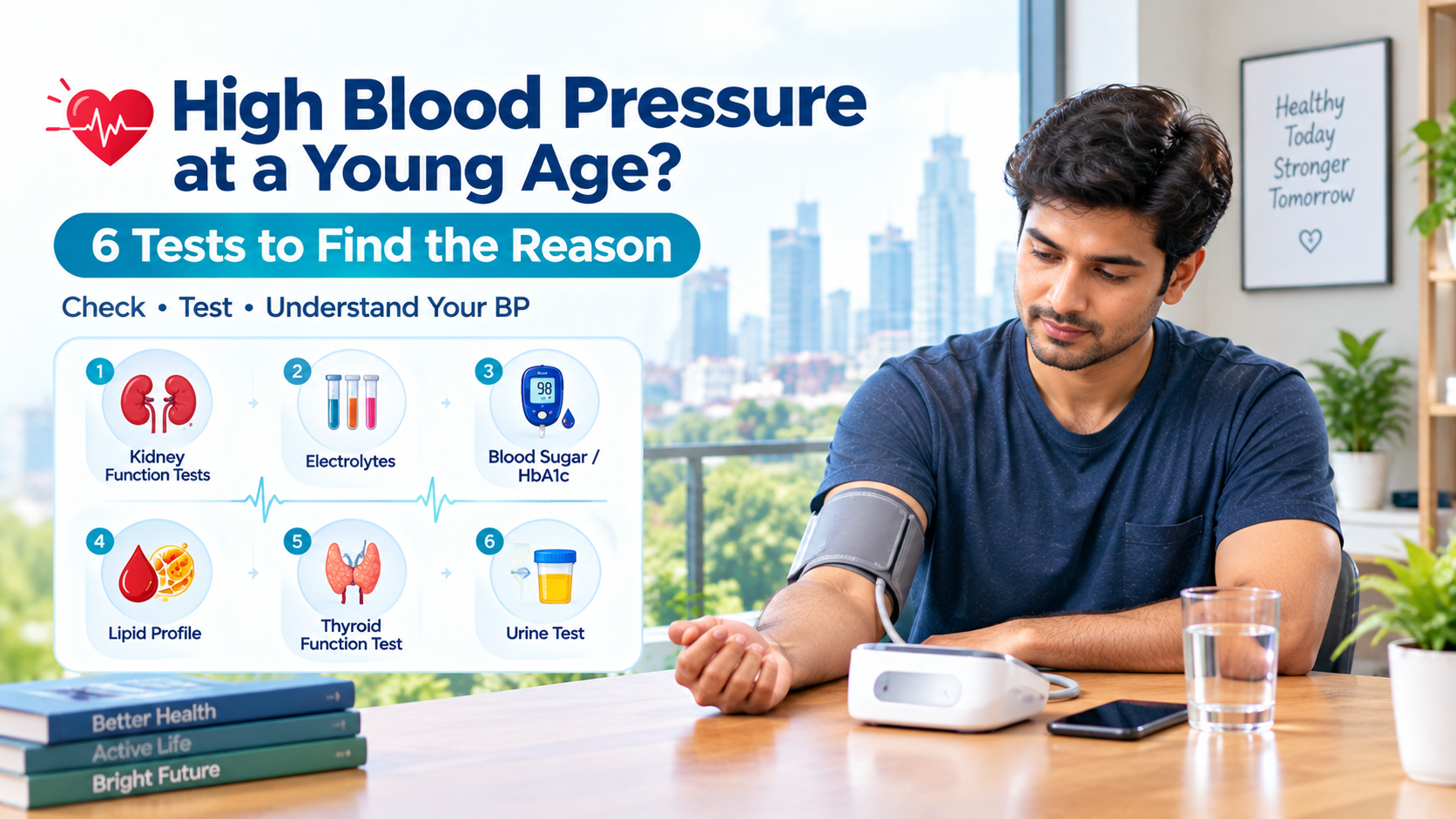
Being told you have high blood pressure when you are in your 20s or 30s can be unexpected. After all, many people associate BP problems with older age. However, High Blood Pressure at a Young Age can happen for several reasons, including family history, weight gain, high-salt foods, poor sleep, stress, kidney problems, thyroid disorders, and other health conditions.
Moreover, a single high reading does not always confirm hypertension. Blood pressure can temporarily rise because of stress, pain, caffeine, exercise, or the clinical setting. Therefore, your doctor may recommend repeat measurements at home or ambulatory monitoring before confirming the diagnosis.
Once high BP is confirmed, however, the next question is important: why is it happening so early?
This Blog Includes:
 Why Is High Blood Pressure at a Young Age Different?
High blood pressure at a younger age can still be primary hypertension, particularly when there is a family history or lifestyle-related risk factors.
However, early-onset, severe, rapidly developing, or difficult-to-control hypertension can sometimes prompt evaluation for secondary causes. These can include kidney disease, thyroid disorders, sleep apnea, certain medications, hormonal conditions, or problems affecting the blood vessels supplying the kidneys.
Therefore, instead of assuming that stress alone is responsible, it is useful to look at the broader picture.
First, Confirm That Your BP Is Actually High
Before searching for a cause, the first step is confirming the blood pressure pattern.
For example, your doctor may ask you to take readings at home at different times of day. This is particularly useful because some people have higher readings in a clinic but normal readings outside it.
Consequently, keep a record of:
Why Is High Blood Pressure at a Young Age Different?
High blood pressure at a younger age can still be primary hypertension, particularly when there is a family history or lifestyle-related risk factors.
However, early-onset, severe, rapidly developing, or difficult-to-control hypertension can sometimes prompt evaluation for secondary causes. These can include kidney disease, thyroid disorders, sleep apnea, certain medications, hormonal conditions, or problems affecting the blood vessels supplying the kidneys.
Therefore, instead of assuming that stress alone is responsible, it is useful to look at the broader picture.
First, Confirm That Your BP Is Actually High
Before searching for a cause, the first step is confirming the blood pressure pattern.
For example, your doctor may ask you to take readings at home at different times of day. This is particularly useful because some people have higher readings in a clinic but normal readings outside it.
Consequently, keep a record of:
- Article Title: High Blood Pressure at a Young Age? 6 Tests to Find the Reason
- Target Keyword: High Blood Pressure at a Young Age
- Search Intent: People under 40 recently told they have high BP
- Topics Covered: Young-onset hypertension, secondary causes, kidney health, thyroid, cholesterol, blood sugar, urine findings, sleep apnea, and stress
- Tests Covered: KFT, Electrolytes, TSH, Lipid Profile, HbA1c, Urine Test
- Additional Evaluation: Sleep study, hormonal testing and kidney/vascular imaging when clinically indicated
- Local SEO Focus: Bengaluru, Bengaluru IT professionals, work stress, salt-heavy food, less sleep
- FAQ Section: Included.
Why Is High Blood Pressure at a Young Age Different?
High blood pressure at a younger age can still be primary hypertension, particularly when there is a family history or lifestyle-related risk factors.
However, early-onset, severe, rapidly developing, or difficult-to-control hypertension can sometimes prompt evaluation for secondary causes. These can include kidney disease, thyroid disorders, sleep apnea, certain medications, hormonal conditions, or problems affecting the blood vessels supplying the kidneys.
Therefore, instead of assuming that stress alone is responsible, it is useful to look at the broader picture.
First, Confirm That Your BP Is Actually High
Before searching for a cause, the first step is confirming the blood pressure pattern.
For example, your doctor may ask you to take readings at home at different times of day. This is particularly useful because some people have higher readings in a clinic but normal readings outside it.
Consequently, keep a record of:
- Morning BP
- Evening BP
- Pulse rate
- Date and time
- Any symptoms
- Medicines or supplements being taken
- KFT: Check Kidney Function
- Electrolytes: Look at Sodium and Potassium
- TSH: Check the Thyroid
- Lipid Profile: Check Cholesterol
- HbA1c: Check Long-Term Blood Sugar
- Urine Test: Look for Kidney-Related Clues
- BP beginning at a very young age
- Very high BP
- Rapidly worsening BP
- Difficult-to-control hypertension
- Abnormal potassium levels
- Abnormal kidney function
- Protein in the urine
- Symptoms suggesting thyroid or hormonal disease
- Symptoms suggesting sleep apnea
- Blood pressure monitoring
- Kidney function
- Electrolytes
- Urine testing
- Lipid profile
- Blood glucose or HbA1c
- Medication review
- Weight and lifestyle factors
- KFT
- Electrolytes
- Lipid Profile
- HbA1c
- TSH when indicated
- Routine urine examination
- Additional urine protein testing when indicated
- Sleep study if sleep apnea is suspected
- Hormonal testing when specific symptoms or laboratory findings suggest it
- Kidney or vascular imaging when clinically indicated