
Why Do Your Reports Differ Between Two Labs? NABL Explained
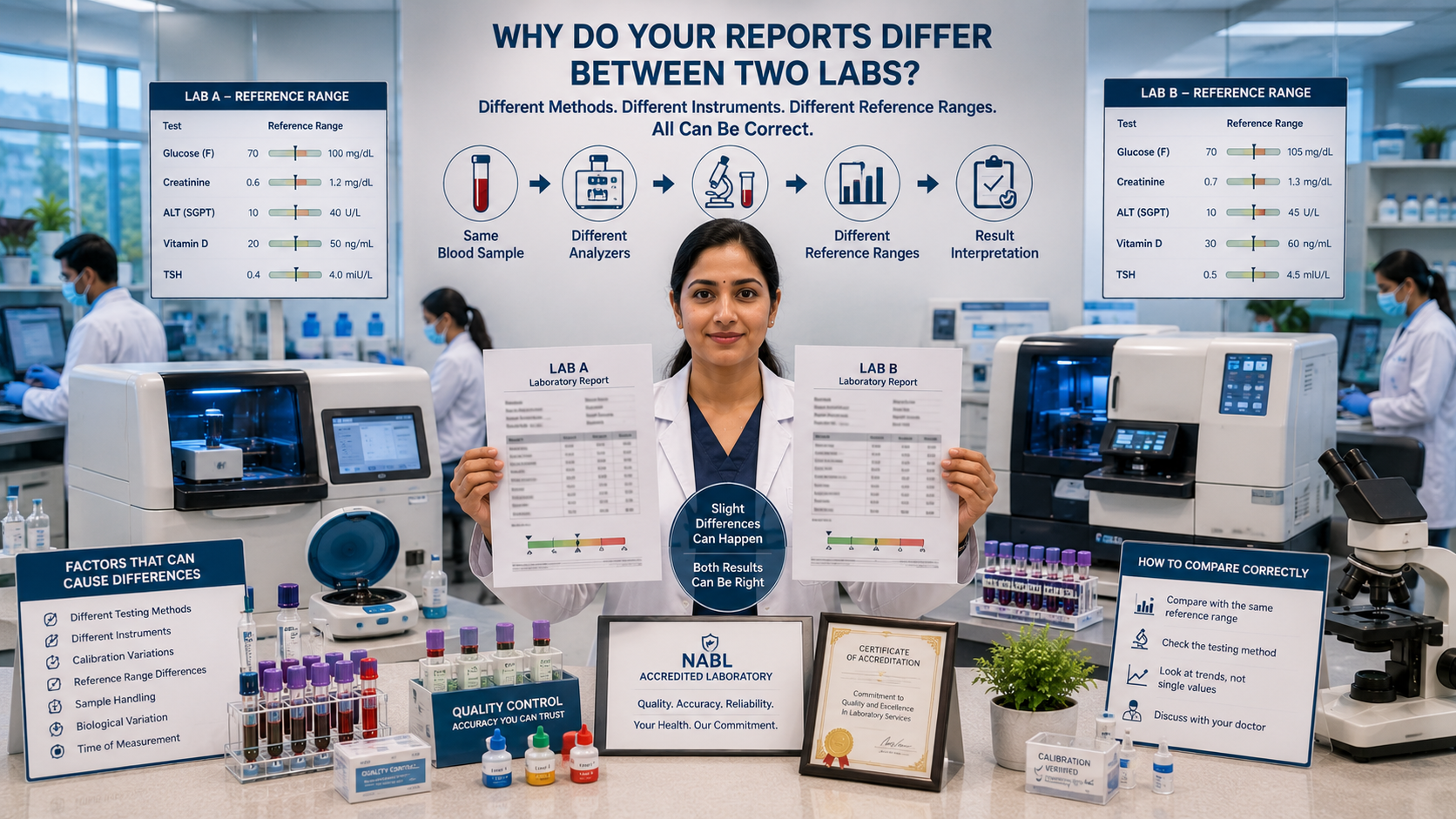
Why Blood Test Reports Differ Between Two Labs
Blood test results can differ between two laboratories because of differences in testing methods, instruments, calibration, sample handling, reference ranges, and laboratory procedures. A small variation does not necessarily mean that one report is wrong. Instead, results should be interpreted using the laboratory's own reference range, the test method, clinical context, and previous results.
For Bengaluru patients comparing labs, this can be particularly frustrating when a blood test performed at one laboratory produces a slightly different number from a test performed elsewhere. Furthermore, people seeking a second opinion may become concerned when two reports do not look identical.
However, understanding why blood test results differ between labs can make these differences much easier to interpret. More importantly, choosing a laboratory with robust quality systems and appropriate accreditation can improve confidence in your testing process.
This Blog Includes:
 The Frustrating Problem of Different Results
Imagine that you have a blood test at Lab A and receive a cholesterol result of one value. A few days later, you repeat the same test at Lab B and receive a slightly different number.
Naturally, you may wonder:
The Frustrating Problem of Different Results
Imagine that you have a blood test at Lab A and receive a cholesterol result of one value. A few days later, you repeat the same test at Lab B and receive a slightly different number.
Naturally, you may wonder:
- Article Title: Why Do Your Reports Differ Between Two Labs? NABL Explained
- Publisher: Prima Diagnostics
- Type: Myth / Decision Guide Healthcare Blog
- Topics Covered: Differences Between Laboratory Results, Blood Test Result Variation, Laboratory Testing Methods, Analyzer Differences, Calibration, Reference Ranges, Sample Collection, Biological Variation, NABL Accreditation, Quality Control, External Quality Assessment, Second Opinions, Laboratory Comparison, Consistent Health Monitoring, and Patient Education.
- Services Covered: Blood Tests, Biochemistry Testing, Haematology Testing, Hormone Testing, Immunoassays, Specialized Laboratory Testing, Preventive Health Screening, Home Sample Collection, Digital Reports, and Laboratory Diagnostics.
- Laboratory Quality Topics Covered: Testing Methodology, Analyzer Performance, Calibration, Internal Quality Control, External Quality Assessment, Sample Handling, Laboratory Documentation, Staff Competency, and Quality Management Systems.
- Educational Guidance: Explains why results can vary between laboratories, how biological and analytical variation affect results, why reference ranges may differ, how testing methods and instruments influence measurements, and how patients can correctly compare reports.
- NABL Guidance: Explains the role of NABL accreditation in assessing laboratory competence and quality-management systems within an accredited scope. Clarifies that NABL accreditation does not guarantee identical numerical results across different laboratories.
- Report Comparison Guidance: Patients should compare the exact test name, units, reference range, testing date, sample preparation, testing method where relevant, and clinical context before interpreting differences between reports.
- Consistency Guidance: Using the same trusted laboratory for regular monitoring can make longitudinal trends easier to interpret, particularly for tests such as HbA1c, thyroid testing, lipid profile, liver enzymes, kidney function and vitamin levels.
- Preparation Guidance: Follow the preparation instructions provided for each individual test. Fasting, exercise, hydration, medication timing and time of sample collection may influence certain laboratory results. Follow any specific instructions given by your healthcare provider.
- Service Focus: Laboratory Quality Awareness, Reliable Diagnostic Testing, NABL Accreditation Awareness, Second-Opinion Guidance, Consistent Health Monitoring, Home Sample Collection, Digital Reporting, and Patient Education.
- FAQ Section: Included.
The Frustrating Problem of Different Results
Imagine that you have a blood test at Lab A and receive a cholesterol result of one value. A few days later, you repeat the same test at Lab B and receive a slightly different number.
Naturally, you may wonder:
- Which report is correct?
- Did one laboratory make a mistake?
- Has my health changed?
- Should I repeat the test again?
- Which number should I show my doctor?
- Fasting status
- Hydration
- Exercise before testing
- Time of sample collection
- Tourniquet use
- Sample transport
- Time between collection and processing
- Food intake
- Stress
- Physical activity
- Sleep
- Medication
- Hydration
- Time of day
- Recent illness
- Testing methodology
- Analyzer system
- Population used to establish the interval
- Statistical approach
- Laboratory-specific validation
- Units
- Reference range
- Testing method
- Date of testing
- Symptoms
- Medications
- Clinical history
- Biochemistry
- Immunoassays
- Hormone testing
- Haematology
- Molecular testing
- Quality management
- Technical competence
- Testing procedures
- Equipment management
- Staff competency
- Documentation
- Quality control
- Were you fasting?
- Did you exercise heavily?
- Did you take your usual medicines?
- Was the sample collected at a similar time?
- HbA1c
- Thyroid levels
- Lipid Profile
- Liver enzymes
- Kidney function
- Vitamin levels
- A repeat test
- A confirmatory test
- A different method
- Additional investigations
- No repeat testing at all
- The result is unexpected
- The result conflicts with symptoms
- Sample quality was questionable
- The value is close to an important clinical decision point
- The healthcare provider wants confirmation
- There was a significant preparation difference
- Test name
- Result
- Units
- Reference range
- Relevant method information where applicable